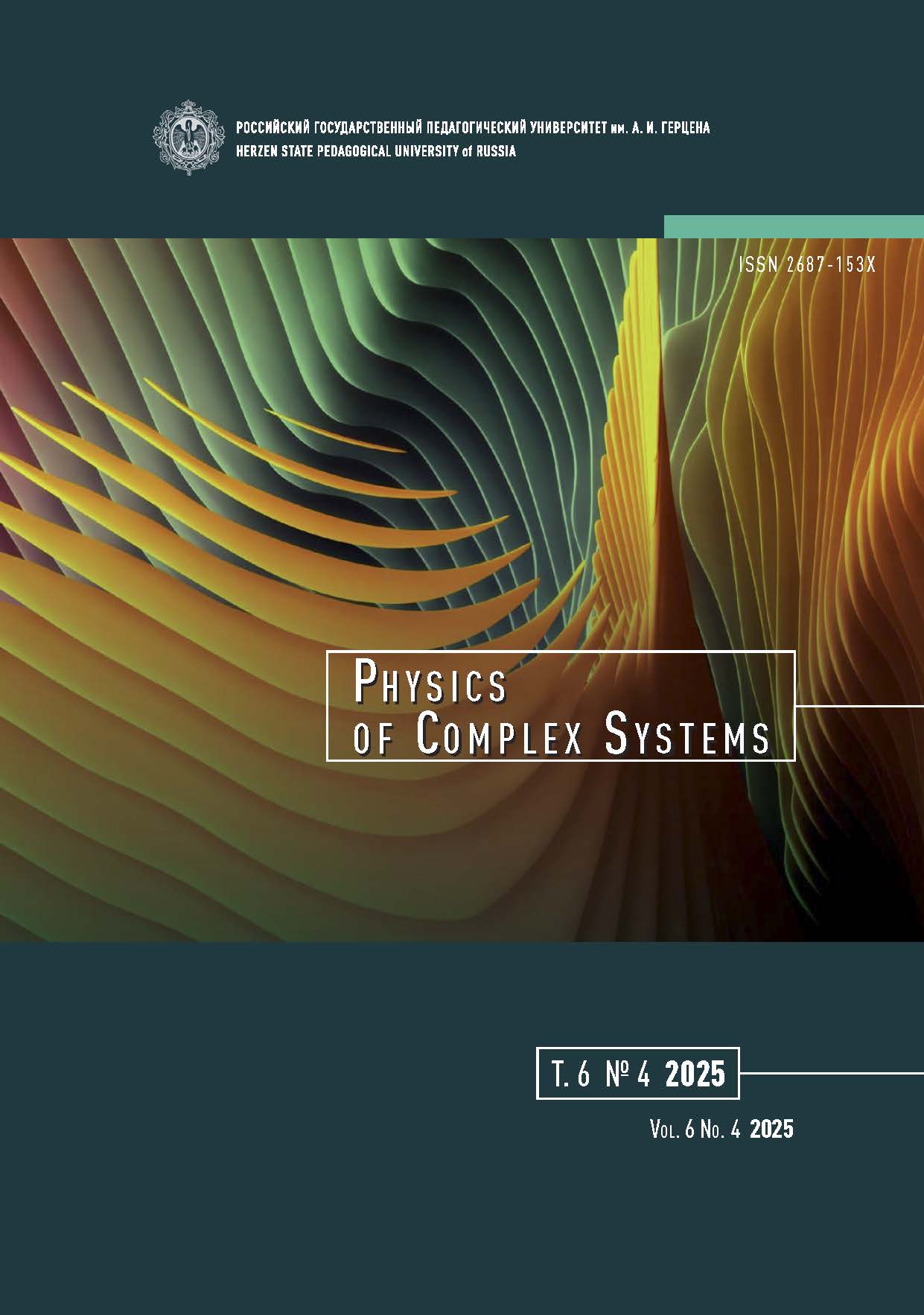
Description of the chaotic state of a nonlinear dynamical system using a smoothed distribution function
DOI:
https://doi.org/10.33910/2687-153X-2025-6-4-196-206Keywords:
nonlinear dynamics, chaos, distribution function, probability density, chaotic attractor, fluctuations of the distribution function, radiation spectraAbstract
This paper considers the possibility of describing the chaotic state of dynamical systems using
a distribution function. It is shown that for dissipative systems, a description employing a distribution
function similar to that used in statistical physics is inadequate. This is explained by the fact that with long
evolution times, the corresponding function ceases to be continuous. A definition for a smoothed distribution
function, obtained through a specific averaging of the statistical distribution function, is proposed. The equation
for the smoothed distribution function is derived. The results are applied to calculate the emission spectra
of dynamical systems in a chaotic state.
References
Gonchenko, A. S., Gonchenko, S. V., Kazakov, A. O., Kozlov, A. D. (2017) Matematicheskaya teoriya dinamicheskogo khaosa i ee prilozheniya: Obzor. Chast’ 1. Psevdogiperbolicheskie attraktory [Mathematical theory of dynamical chaos and its applications: Review. Part 1. Pseudohyperbolic attractors. Pseudohyperbolic attractors]. Izvestiya Vysshikh uchebnykh zavedeniy. Prikladnaya nelineynaya dinamika — Izvestiya VUZ. Applied Nonlinear Dynamics, 25 (2), 4–36. https://doi.org/10.18500/0869-6632-2017-25-2-4-36 (In Russian)
Gorbacheva, A. S., Ryzhov, I. V. (2022) Analytical regularities of inversionless superradiance. Physics of Complex Systems, 3 (2), 66–74. http://dx.doi.org/10.33910/2687-153X-2022-3-2-66-74 (In English)
Grinchenko, V. T., Matsipura, V. T., Snarskij, A. A. (2007) Vvedenie v nelinejnuyu dinamiku. Khaos i fraktaly [Introduction to Nonlinear dynamics. Chaos and fractals]. 2nd ed. Moscow: URSS Publ., 283 p. (In Russian)
Kamke, E. (1967) Differentialgleichungen Lösungsmethoden und Lösungen [Differential equations: Solution methods and solutions.]. Vol. 2. Leipzig: Akademische Verlag, 668 p. (In German)
Kondratyev, A. S., Liaptsev, A. V. (2008) Fizika. Zadachi na komp’yutere [Physics. Tasks on the computer]. Moscow: “Fiziko-matematicheskaya literatura” Publ., 400 p. (In Russian)
Kuni, F. V. (1981) Statisticheskaya fizika i termodinamika [Statistical physics and thermodynamics]. Moscow: Nauka Publ., 352 p. (In Russian)
Kuznetsov, S. P. (2006) Dinamicheskij khaos: Kurs lektsij. Uchebnoe posobie dlya vuzov [Dynamic chaos: A course of lectures. Textbook for]. 2nd ed. Moscow: “Fiziko-matematicheskaya literatura” Publ., 356 p. (In Russian)
Liaptsev, A. V. (2010) Strannyj attraktor v prostejshej mekhanicheskoj sisteme [A strange attractor in the simplest mechanical system]. Komp’yuternye instrumenty v obrazovanii — Computer Tools in Education Journal, 6, 57–66. (In Russian).
Liaptsev, A. V. (2021) Spontaneous symmetry breaking and superposition of states in systems with dynamic chaos. Physics of Complex Systems, 2 (3), 122–131. https://www.doi.org/10.33910/2687-153X-2021-2-3-122-131 (In English)
Liapzev, A. V. (2019) The calculation of the probability density in phase space of a chaotic system on the example of rotator in the harmonic field. Computer Assisted Mathematics 1, 55–65. (In English)
Lifshitz, E. M., Pitaevskii, L. P. (1981) Physical Kinetics. Vol. 10. Oxford: Butterworth-Heinemann Publ., 452 p. (In English)
Loskutov, A. Yu. (2007) Dynamical chaos: Systems of classical mechanics. Physics – Uspekhi, 50 (9), 939–964. https://doi.org/10.1070/PU2007v050n09ABEH006341 (In English)
Malinetsky, G. G., Potapov, A. B. (2000) Sovremennye problemy nelinejnoj dinamiki [Modern problems of nonlinear dynamics]. Moscow: Editorial URSS Publ., 336 p. (In Russian)
Ryzhov, I. V., Kovyneva, E. S., Devyatkov, A. M. (2024) Superradiation in a Medium Consisting of Two Ultra-Thin Layers, Considering the Influence of Homogeneous and Inhomogeneous Spectral Line Broadening. Bulletin of the Russian Academy of Sciences: Physics, 88 (6), 909–921. https://doi.org/10.1134/S1062873824706810 (In English)
Ryzhov, I. V., Malikov, R. F., Malyshev, A. V., Malyshev, V. A. (2019) Nonlinear optical response of a two-dimensional quantum-dot supercrystal: Emerging multistability, periodic and aperiodic self-oscillations, chaos, and transient chaos. Physical Review A, 100 (3), article 033820. https://doi.org/10.1103/PhysRevA.100.033820 (In English)
Ryzhov, I. V., Malyshev, V. A., Malikov, R. F., Malyshev, A. V. (2021) Quantum metasurfaces of arrays of Λ-emitters for photonic nano-devices. Journal of Optics, 23 (11), article 115102. https://doi.org/10.1088/2040-8986/ac2788 (In English)
Ryzhov, I. V., Malyshev, V. A., Malikov, R. F., Malyshev, A. V. (2021) Nonlinear optical dynamics of 2D super-crystals of quantum Λ-emitters. Journal of Physics: Conference Series, 2103 (1), article 012226. https://doi.org/10.1088/1742-6596/2103/1/012226 (In English)
Sagdeev, R. Z., Usikov, D. A, Zaslavskii, G. M. (1988) Nonlinear physics: From the pendulum to turbulence and chaos. New York: Harwood Academic Publ., 675 p. (In English)
Schuster, G. H. (1984) Deterministic chaos. An introduction. Weinheim: Physik-Verlag, 304 p. (In English)
Downloads
Published
Issue
Section
License
Copyright (c) 2025 Alexander V. Liaptsev

This work is licensed under a Creative Commons Attribution 4.0 International License.
The work is provided under the terms of the Public Offer and of Creative Commons public license Creative Commons Attribution 4.0 International (CC BY 4.0).
This license permits an unlimited number of users to copy and redistribute the material in any medium or format, and to remix, transform, and build upon the material for any purpose, including commercial use.
This license retains copyright for the authors but allows others to freely distribute, use, and adapt the work, on the mandatory condition that appropriate credit is given. Users must provide a correct link to the original publication in our journal, cite the authors' names, and indicate if any changes were made.
Copyright remains with the authors. The CC BY 4.0 license does not transfer rights to third parties but rather grants users prior permission for use, provided the attribution condition is met. Any use of the work will be governed by the terms of this license.